
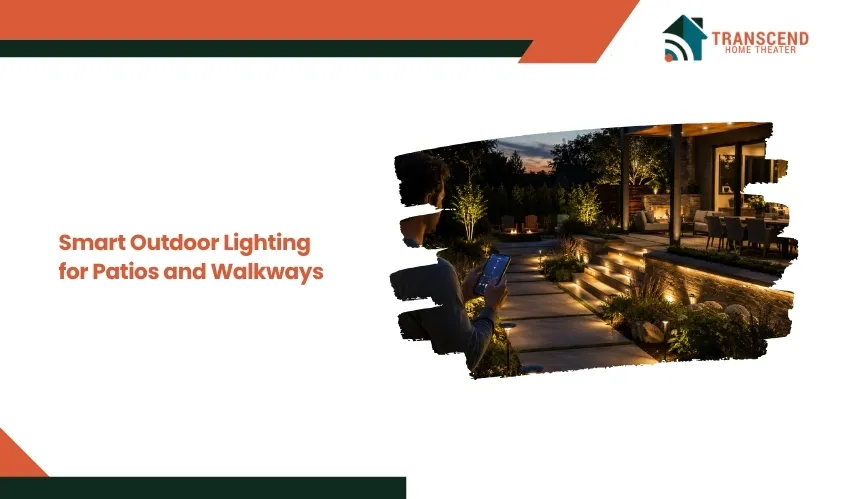
Smart Outdoor Lighting for Patios and Walkways
Key Takeaways
|
Outdoor spaces need more than basic illumination. Patios require comfortable, adjustable light for dining and relaxation, while walkways need consistent visibility around steps, turns, and changes in elevation.
Smart outdoor lighting adds control through automated schedules, motion sensors, dimming, and lighting scenes, allowing each area to respond to how and when it is used. The right setup can improve nighttime safety and usability without excessive brightness or wasted energy.
This guide covers how to choose, position, control, and plan smart lighting for patios and walkways.
How Smart Lighting Improves Patios and Walkways
Smart outdoor lighting improves how patios and walkways function after dark by directing the right amount of light where and when it is needed. Instead of operating every fixture at one fixed brightness, a smart system can adapt illumination to movement, activity, and time of day.
Smart Lighting Improves Outdoor Visibility
Effective outdoor lighting makes changes in the walking surface easier to identify before someone reaches them. Steps, pathway edges, entrances, elevation changes, and transitions between patios and walkways need enough contrast for people to recognize potential obstacles.
More brightness does not automatically produce better visibility. Excessive output or poorly aimed fixtures can create glare, making darker areas harder to see as the eyes adjust between high- and low-light zones. Controlled illumination provides clearer visual guidance while keeping the surrounding environment comfortable.
Outdoor Lighting Automation Adds Convenience
Automation allows exterior lights to operate according to predefined conditions rather than requiring someone to remember a switch. Timers, schedules, sunset-based triggers, and motion detection can activate lighting when outdoor areas are likely to be occupied.
This is particularly useful when arriving home after dark or moving between indoor and outdoor spaces. A pathway can illuminate automatically when needed, while patio lights can follow an evening schedule. The result is predictable lighting behavior without unnecessary manual control.
Creating a More Comfortable Outdoor Atmosphere
Patios and walkways serve different purposes, so they should not share identical lighting intensity. A walkway primarily requires clear visual guidance, while a patio may need softer ambient light combined with brighter illumination around doors, tables, or activity areas.
Dimming and adjustable light levels make those differences easier to manage. Brighter settings can support outdoor dining or tasks, while lower levels create a more relaxed environment for conversation or late-evening use. Matching light output to the activity keeps outdoor spaces functional without making them feel overlit.
Choosing the Right Lighting for Patios and Walkways
The right outdoor fixture depends on what the space needs people to see and do. Patio lighting typically combines several light sources for different activities, while walkway lighting concentrates illumination closer to the ground for navigation.
What Type of Lighting Works Best for a Patio?
Patios benefit from layered lighting rather than a single high-output fixture. Wall sconces and downlights can establish general illumination, while focused fixtures provide task lighting near grills, outdoor kitchens, dining tables, and doors. Accent lights can define architectural details or landscaping without dominating the functional lighting.
Fixture selection should also reflect the patio layout. Covered patios can accommodate overhead lighting, while open patios may depend more heavily on wall-mounted, recessed, or integrated landscape fixtures. Separating ambient, task, and accent lighting makes it easier to adjust the space for dining, entertaining, or quieter evening use.
What Lighting Is Best for Walkways?
Path lights, step lights, bollards, and low-level recessed fixtures are designed to illuminate walking surfaces without directing excessive light toward eye level. Selection should account for pathway width, curves, stairs, grade changes, and connections to driveways or entrances.
Fixture output and beam spread also determine how many lights are necessary. A wider controlled beam may cover more walking surface than several closely spaced fixtures. In established Chevy Chase neighborhoods, where walkways may pass mature trees, landscaped beds, stone steps, or older home entrances, fixture selection should respond to those physical features rather than impose a uniform lighting pattern.
Choosing Outdoor-Rated Fixtures for Maryland Conditions
Exterior fixtures in Maryland must tolerate year-round exposure to rain, humidity, freezing conditions, summer heat, and seasonal temperature changes. Fixtures installed where precipitation can reach them should carry the appropriate wet-location rating, while damp-location-rated products are generally intended for protected areas where direct water exposure is limited.
Material durability also matters. Corrosion-resistant housings, sealed electrical components, and outdoor-rated connections reduce the risk of moisture intrusion and premature deterioration.
These specifications are particularly relevant for low-mounted walkway and landscape fixtures because they experience direct exposure to wet soil, runoff, snow, and lawn irrigation.
Where Should Smart Outdoor Lights Be Placed?
Smart outdoor lights should be positioned around changes in movement, activity, and visibility rather than distributed at equal intervals everywhere. Effective placement defines usable areas, reveals hazards, and controls where light reaches after dark.
Where Should Lights Be Positioned Around a Patio?
Start with transition points such as exterior doors, patio steps, changes in surface level, and routes leading toward the house or yard. From there, place dedicated fixtures around functional areas such as dining tables, grills, outdoor kitchens, and seating zones according to the amount and direction of light each activity requires.
Fixture height and aiming angle affect visual comfort. Downward-directed wall lights can illuminate circulation areas without shining directly toward seated occupants, while carefully positioned accent fixtures can add depth around the patio perimeter. This approach prevents the flat appearance created when one central fixture floods the entire space.
How Far Apart Should Walkway Lights Be?
There is no universal spacing measurement for walkway lights. Distance should be determined by fixture lumen output, beam spread, mounting height, path width, curves, vegetation, and changes in grade. The objective is to maintain visual continuity along the walking surface without producing a sequence of isolated bright spots.
Staggering fixtures can work better than placing matching lights directly opposite each other. On curved or irregular paths, lights can be concentrated near turns, intersections, stairs, and surface transitions while longer unobstructed sections may require fewer fixtures.
How Can Outdoor Lighting Reduce Glare and Light Spill?
Glare occurs when the light source is too bright or directly visible from common viewing angles. Shielded fixtures, downward-facing optics, lower mounting positions, and controlled beam angles keep illumination focused on patios and walking surfaces instead of occupants’ eyes.
The same placement decisions reduce light trespass into neighboring properties and unnecessary upward illumination. This can be especially relevant in Chevy Chase, where homes can have landscaped yards, mature tree canopies, and neighboring residential properties relatively close to outdoor living areas.
Precise fixture aiming keeps useful light within the intended zone instead of illuminating windows, adjacent yards, or the night sky.
Smart Controls That Make Outdoor Lighting More Useful
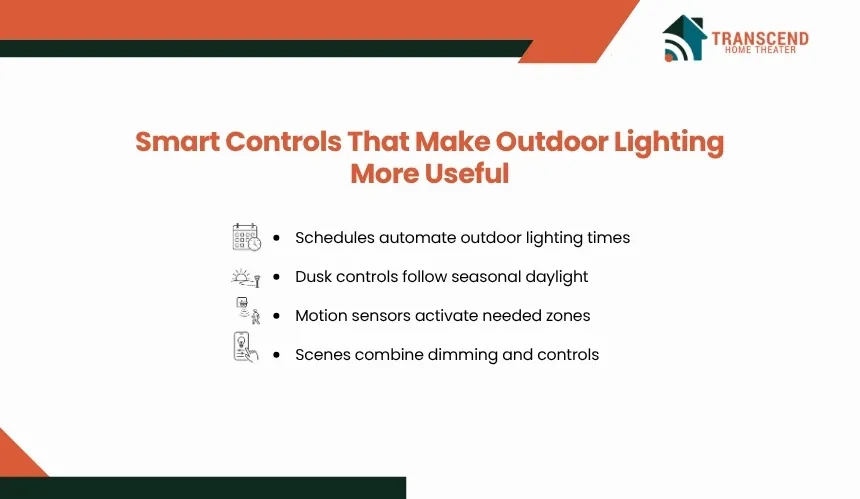
Smart controls determine when outdoor fixtures operate and how they respond to changing conditions. The most practical systems combine time-based automation, sensor inputs, and adjustable scenes so patios and walkways do not depend on a single on-or-off setting.
How Do Schedules and Dusk-to-Dawn Controls Work?
Fixed schedules switch outdoor lights at programmed times, while dusk-to-dawn controls respond to available daylight. Smart systems can also use astronomical scheduling, which automatically adjusts activation times as sunset and sunrise shift throughout the year.
That flexibility is useful in Maryland, where sunset times vary considerably between summer and winter. Instead of repeatedly changing a fixed timer, an astronomical schedule can keep exterior lighting synchronized with seasonal daylight patterns.
Different zones can also follow separate schedules, allowing entry and walkway lights to remain active longer than patio fixtures.
Where Should Motion Sensors Control Outdoor Lighting?
Motion-based controls work best in areas where continuous full-output lighting is unnecessary, such as side paths, gates, exterior stairs, secondary entrances, and less frequently used sections of a property. Detection can trigger a specific fixture or lighting zone when someone approaches.
Sensor range, direction, and sensitivity require careful configuration. A sensor aimed toward a road, sidewalk, moving vegetation, or neighboring property may cause frequent unwanted activation. Proper positioning limits detection to relevant movement and produces more predictable automation.
Another option is to maintain low-level illumination after dark and temporarily increase brightness when motion is detected. This preserves basic visibility while providing stronger light only when someone enters the area.
Lighting Scenes, Dimming, and Smart Home Control
Lighting scenes allow several fixtures or zones to change together through one command. A dining scene might raise task lighting around a patio table while keeping surrounding fixtures lower, whereas an arrival scene can activate the entrance and primary walkway simultaneously.
Dimming adds another layer of control because the same fixture can support different activities without operating at maximum output throughout the evening. Compatible systems may also connect outdoor lighting with mobile apps, voice assistants, keypads, or broader smart home automation platforms.
For homeowners already using automated lighting indoors, integrating exterior zones into the same control system can create consistent operation across the property. A single command, for example, can shut down patio lighting while retaining selected pathway and entry lights for nighttime circulation.
How to Plan a Smart Outdoor Lighting System That Works Long Term
A reliable outdoor lighting system should be planned as connected zones rather than a collection of individual fixtures. Power requirements, controls, connectivity, and future expansion should be considered before installation.
1. Divide the Outdoor Space Into Lighting Zones
Separate patios, walkways, entrances, stairs, and landscape areas according to how each space is used. Independent zones allow each area to operate at appropriate times and settings without activating the entire exterior lighting system.
2. Consider Power, Connectivity, and Compatibility
Determine whether the system will use line-voltage or low-voltage fixtures and whether control will come from smart switches, relays, or integrated smart fixtures. Wi-Fi coverage, hubs, sensors, and automation-platform compatibility should also be verified before equipment is selected.
3. Balance Safety, Ambiance, and Energy Use
LED fixtures combined with zoning, dimming, and automated shutoff can reduce unnecessary operating time. Higher output can be reserved for circulation and task areas, while decorative or low-use zones operate at lower levels.
When Does Professional Lighting Planning Make Sense?
Larger patios, long pathways, multiple control zones, and integration with existing home automation can require coordinated electrical and system design. For smart lighting installation in Chevy Chase, MD, professional planning can also account for the area’s established homes, mature landscaping, and existing electrical infrastructure when determining fixture locations, wiring routes, and control integration.
Bring smarter control to every space with Transcend Home Theater. From home theaters and home automation to automated lighting installation, we design integrated systems for homes across Maryland, Virginia, and Washington, DC. Contact us to create a smarter, more connected home indoors and out.
Frequently Asked Questions
Can existing landscape lights be upgraded to smart controls without replacing every fixture?
Many existing outdoor lighting systems can be modernized by adding compatible smart switches, relays, transformers, or control modules rather than replacing every fixture. The best approach depends on whether the system uses line voltage or low voltage, how circuits are grouped, and whether the existing LED drivers support dimming or automation.
What color temperature is best for patio and walkway lighting?
Warm white light around 2700K to 3000K generally works well for patios because it creates a softer residential appearance. Walkways may use slightly cooler light when clearer visual contrast is needed. Consistency matters across connected outdoor zones, since mixing noticeably different color temperatures can make the landscape appear fragmented after dark.
Will smart outdoor lights still work if the Wi-Fi goes down?
That depends on the control architecture. Systems that rely entirely on cloud-connected devices may lose app or voice control during an internet outage, while locally controlled switches, hubs, schedules, or keypads can often continue operating. Homeowners prioritizing reliability should consider systems that retain basic lighting functions without continuous internet access.
Are smart bulbs or smart switches better for outdoor lighting?
Smart switches or centralized controls are usually more practical when several outdoor fixtures operate together because one control point can manage an entire circuit. Smart bulbs provide individual fixture control but require compatible housings, continuous power, and reliable connectivity. The better choice depends on zoning requirements, fixture count, and desired automation flexibility.
Can smart outdoor lighting be added to a low-voltage landscape system?
Low-voltage landscape lighting can often be integrated with smart controls through compatible transformers, relays, timers, or automation modules. The transformer must support the connected load and control method. Existing wiring condition, fixture wattage, dimming requirements, and circuit layout should be evaluated before adding smart functionality to an established system.
Do smart outdoor lights use much electricity when they are turned off?
Most smart lighting devices draw a small amount of standby power so their wireless radios, sensors, or control electronics remain available. The standby consumption is typically much lower than the energy used when fixtures are illuminated. Overall energy use depends more heavily on fixture wattage, operating hours, dimming levels, and automation settings.