
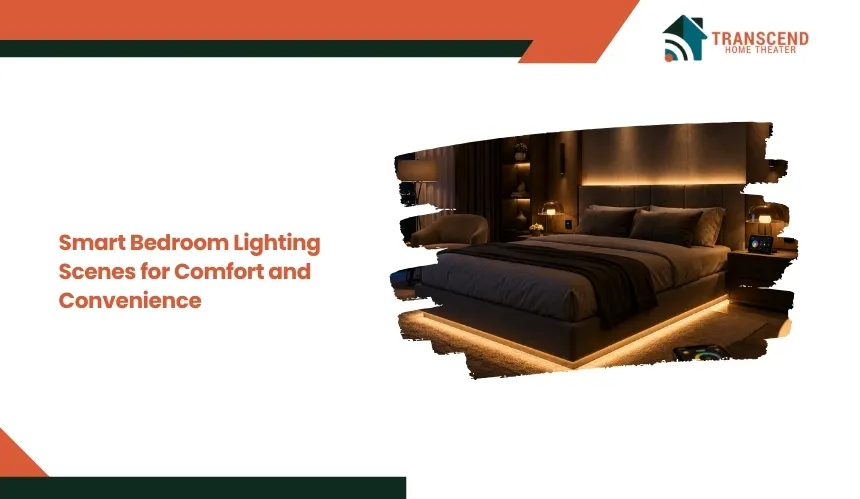
Smart Bedroom Lighting Scenes for Comfort and Convenience
Key Takeaways
|
Bedroom lighting needs change throughout the day, but manually adjusting multiple fixtures every time can make those changes inconvenient. Smart bedroom lighting scenes solve this by using preset lighting conditions for specific activities, from waking up and getting ready to reading and preparing for sleep.This guide covers practical smart bedroom lighting scenes and how to configure them for comfort, convenience, and everyday use.
How Do Smart Lighting Scenes Improve Bedroom Comfort and Convenience?
Smart lighting scenes make bedroom lighting easier to manage by storing multiple lighting settings as a single preset. Instead of controlling each fixture separately, one scene can activate the required lights at predetermined levels for a specific bedroom activity.
A scene can coordinate several variables at once, including fixture selection, dimming level, color temperature, and timing. For example, the same ceiling fixture, bedside lamp, and wall sconce can operate differently depending on the selected preset. This allows the lighting environment to change without requiring several individual adjustments.
The main advantage over basic smart bulb control is coordination. Turning a smart bulb on or off changes one device, while a lighting scene changes a group of compatible fixtures according to predefined settings. Smart switches, dimmers, keypads, or connected lighting controls can also participate, depending on the system design.
Scene-based control also makes lighting more consistent. Once suitable settings are saved, the same lighting conditions can be recalled through a wall control, mobile app, voice command, or automation. Users do not have to remember preferred brightness levels or adjust several devices each time.
The result is a bedroom lighting system organized around repeatable routines rather than individual fixtures. Each preset can provide the amount and type of light required for a particular activity while reducing unnecessary interaction with separate controls.
What Are the Most Useful Smart Bedroom Lighting Scenes?
The most practical smart bedroom lighting scenes correspond to activities that require noticeably different lighting conditions. A small set of purpose-built presets can support morning alertness, grooming, focused reading, evening relaxation, and safe movement after dark.
1. Wake-Up and Morning Scene
A wake-up scene should transition the bedroom from darkness to useful morning illumination without switching immediately to full brightness. Gradually increasing light output can create a smoother transition while providing enough visibility to start the day.
Brighter, cooler-toned light is better suited to the active part of the morning because it creates a clearer visual environment for moving around and beginning daily tasks. The scene can activate automatically at a scheduled wake time, eliminating the need to reach for a switch or phone immediately after waking.
2. Getting Ready and Daytime Scene
Getting dressed, selecting clothing, and grooming require clearer illumination than passive bedroom activities. A getting-ready scene should prioritize even light distribution around wardrobes, mirrors, dressers, and other task areas where accurate visibility matters.
Ambient and task lighting can operate together to reduce dark areas and provide useful illumination where detailed visual work occurs. The goal is functional coverage across the spaces being used rather than simply increasing every bedroom fixture to maximum output.
3. Relaxing and Reading Scene
Relaxation and reading have different visual requirements, so an effective scene should balance soft surrounding light with focused illumination. Lower ambient levels can reduce excessive brightness across the room, while a bedside lamp, wall-mounted reading light, or similar task fixture provides sufficient light for reading.
Warmer light can make the surrounding environment less visually stimulating during evening use. Keeping illumination concentrated around the reading position also prevents unused parts of the bedroom from remaining unnecessarily bright.
4. Bedtime and Night Scene
A bedtime scene should reduce light output and simplify the transition from evening activity to sleep. Dim, warm illumination can provide enough visibility for final tasks without maintaining the brighter conditions used earlier in the day.
After lights-out, a separate low-level night setting can illuminate a pathway to the bathroom, doorway, or bedside area without flooding the room with overhead light. A bedside command can then switch off remaining fixtures together, making the final lighting adjustment possible without leaving the bed.
How Should You Set Brightness and Color Temperature for Each Scene?
Effective bedroom scenes depend on more than choosing which fixtures turn on. Brightness, color temperature, and light distribution determine whether the resulting environment provides enough visibility for the intended activity without creating unnecessary glare or visual discomfort.
Match Brightness to the Activity
Brightness should reflect the amount of visual detail an activity requires. Dressing, grooming, and organizing belongings generally need stronger illumination, while relaxing before bed requires substantially less. Reading falls between these conditions because the task area needs adequate light even when the rest of the bedroom remains relatively dim.
Dimmable fixtures provide greater control than fixed-output lighting because each scene can use a different percentage of the fixture’s available output. The appropriate setting also depends on room size, wall finishes, fixture placement, natural light, and the amount of illumination produced by each light source.
Use Cooler and Warmer Light at the Right Times
Color temperature changes the visual character of bedroom lighting. Cooler white light creates a brighter, more alert appearance that suits morning routines and detail-oriented tasks. Warmer white light produces a softer appearance that is better suited to evening relaxation and preparation for sleep.
Adjustable white lighting allows one fixture to support both conditions instead of requiring separate light sources. This flexibility can be particularly useful in Washington, DC Metro area homes where seasonal changes affect the amount and timing of natural daylight entering a bedroom. Scenes can compensate by changing artificial light according to the time of day rather than relying on one fixed color temperature.
Layer Bedroom Lighting Instead of Controlling Every Fixture the Same Way
Layered lighting separates the bedroom into ambient, task, and accent functions. Ceiling fixtures or recessed lights can provide general illumination, bedside lamps and sconces can serve focused tasks, and accent lighting can illuminate architectural details or selected surfaces.
A well-programmed scene assigns each layer an appropriate output instead of dimming every fixture to the same percentage. This creates better visual balance and allows task areas to remain functional without making the entire room equally bright. The result is a lighting environment shaped around how different parts of the bedroom are actually being used.
How Can You Control and Automate Bedroom Lighting Scenes?
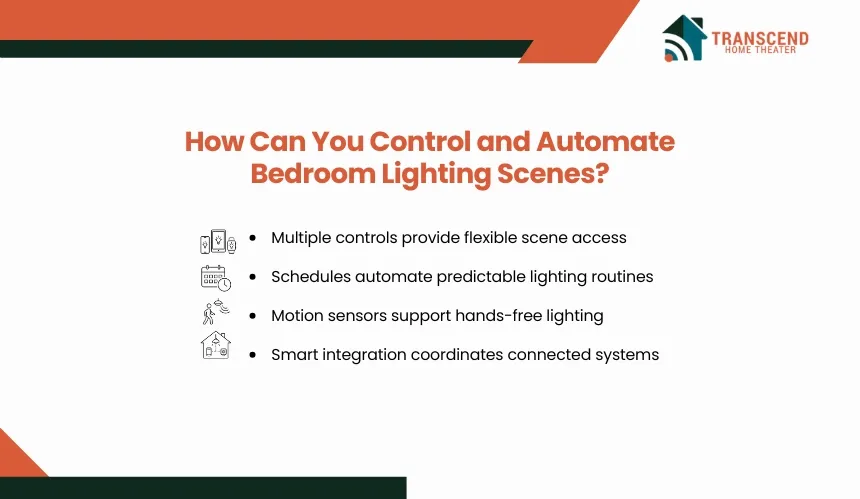
Bedroom lighting scenes become more convenient when users can activate them from the most practical control point or have them respond automatically to predictable conditions. A well-planned smart lighting installation can support manual controls, scheduled routines, and occupancy-based automation, depending on how and when each lighting change needs to occur.
Voice, App, and Bedside Controls
Physical controls remain useful because they provide immediate access without requiring a phone or voice assistant. Wall-mounted smart switches and keypads can assign commonly used scenes to dedicated buttons, while bedside controls allow lights to be changed without crossing the room.
Mobile apps provide access to individual fixtures, scene settings, and system configuration from a smartphone or tablet. Voice control adds hands-free operation for commands such as activating a reading preset or turning off bedroom lights. Combining these interfaces gives users multiple ways to access the same scenes rather than making the system dependent on one control method.
Schedules and Routine-Based Automation
Scheduled automation works best for lighting changes that occur at relatively predictable times. A morning scene can begin around a regular wake time, while evening settings can activate later as the household transitions toward nighttime routines.
Time-based programming can also account for changing daylight conditions. Across the Washington, DC Metro area, sunrise and sunset times shift considerably between seasons, so astronomical scheduling can trigger lighting according to local sunrise or sunset rather than a fixed clock time. This keeps automated scenes better aligned with available natural light throughout the year.
Motion and Occupancy-Based Lighting
Motion and occupancy sensors are useful when lighting should respond without deliberate input. In bedrooms, they can trigger low-level pathway lighting when someone gets out of bed at night or switch off selected fixtures after the room has remained vacant for a defined period.
Sensor placement, sensitivity, timeout duration, and activation conditions require careful configuration. Poorly positioned sensors may detect movement outside the intended area or activate brighter lighting during sleep. Restricting nighttime responses to specific fixtures and low output levels keeps automation useful without making it intrusive.
Smart Home Integration
Professional smart home integration can make a bedroom lighting operate as part of a broader smart home routine rather than as an isolated system. A single command can coordinate compatible lighting controls with motorized shades, climate settings, and other connected devices.
For example, a morning routine can raise motorized shades while adjusting bedroom lighting, while an evening routine can close window coverings and change selected fixtures simultaneously. Integrating these functions reduces the number of separate controls required and allows multiple bedroom systems to respond to the same scheduled event, keypad command, or automation trigger.
How Do You Plan Smart Bedroom Lighting Scenes That Work in Daily Life?
A successful bedroom lighting setup should reduce unnecessary interaction rather than add more controls and presets to manage. The most effective approach is to start with actual household behavior, preserve flexibility, and refine programmed scenes after using them under real conditions.
Build Scenes Around Actual Bedroom Routines
Start by identifying activities that consistently require a different lighting environment. Waking, getting dressed, reading, relaxing, and going to bed may justify dedicated presets, while minor variations usually do not need separate scenes.
The number of scenes should remain manageable. Too many similar presets can make keypads, apps, and voice commands harder to navigate. Each scene should have a clear purpose and a recognizable name so household members can understand what it does without remembering complicated programming.
Bedroom layout should also influence scene planning. Fixture locations, furniture placement, window orientation, and how different areas of the room are used determine which lights need to participate in each preset. Designing around these physical conditions produces more practical results than applying the same scene structure to every bedroom.
Keep Manual Control Available
Automation should not prevent occupants from making immediate lighting changes. Physical dimmers, switches, or keypads provide a reliable way to override a programmed scene when someone needs more or less light than usual.
Manual control is particularly valuable when routines change. Guests, irregular sleep schedules, seasonal habits, or temporary room uses can make a programmed response inappropriate. A flexible system allows occupants to override that response without disabling the underlying automation or reconfiguring the entire scene.
Test and Fine-Tune Each Scene
Initial programming should be treated as a starting point rather than a permanent configuration. Use each scene during its intended activity and evaluate whether the resulting illumination matches how the bedroom functions in practice.
Fine-tuning may involve changing fixture participation, transition speed, scheduling behavior, sensor response, or other scene parameters. Testing across different times of day is especially useful in Washington, DC Metro area homes because changing daylight and seasonal conditions can alter how artificial lighting performs within the same room.
Periodic adjustments keep the system aligned with changing routines, furniture arrangements, and household preferences. The goal is a small set of dependable scenes that occupants can use naturally without having to think about how the lighting system is programmed.
Transcend Home Theater provides smart home automation and smart lighting installation across the Washington, DC Metro area, including Maryland, Virginia, and Northwest DC. From personalized bedroom lighting scenes to integrated whole-home controls, our systems are designed around the way each household uses its space. Contact us to plan a smarter, more intuitive lighting experience.
Frequently Asked Questions
Can I add smart lighting scenes without replacing all my bedroom fixtures?
Most bedrooms can be upgraded without replacing every fixture. Smart dimmers, switches, in-wall modules, and compatible bulbs can add scene control to existing lighting, but compatibility depends on bulb type, dimming load, wiring, and available neutral conductors. Older homes may require an electrical evaluation before selecting controls.
Will my smart bedroom lights still work if the internet goes down?
A well-designed system should preserve basic lighting control during an internet outage. Local switches, dimmers, keypads, and some hub-based systems can continue operating without cloud access, while remote apps and voice assistants may stop working. Choosing local-control architecture reduces dependence on Wi-Fi and external servers for essential bedroom lighting.
How do smart lighting scenes work when two people share a bedroom?
Shared bedrooms need separate control zones rather than one automation profile for both occupants. Individual bedside controls, isolated reading lights, and person-specific wake routines can prevent one user’s schedule from disturbing the other. Automation should also avoid whole-room activation when only one side of the bed needs light.
Are smart bulbs or smart switches better for bedroom lighting?
Smart bulbs are useful when color tuning or individual lamp control is the priority, while smart dimmers or switches are often better for permanent ceiling fixtures and familiar wall control. Mixing the wrong control type can create compatibility problems, especially when a conventional switch cuts power to a smart bulb.
Do all smart lights work with the same smart home system?
Compatibility should be checked at the ecosystem, protocol, and device level before installation. Matter can improve interoperability across participating brands, but not every feature is guaranteed to work identically across every platform. Verify support for scenes, dimming, sensors, voice assistants, and any planned integrations before committing to a system.