
When Should You Choose a Retractable Projection Screen?
Key Takeaways
|
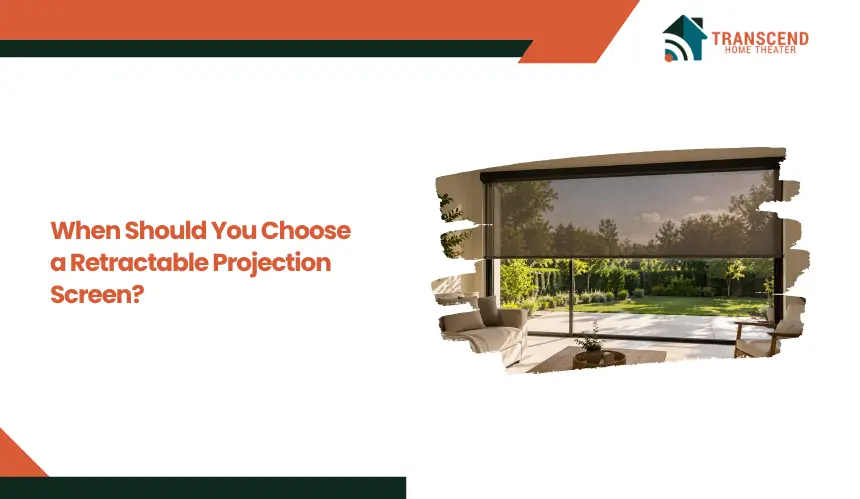
A retractable projection screen is the right choice when a room needs to support both high-quality projection and everyday living without dedicating a permanent wall to a fixed display. The decision depends on factors such as room layout, viewing habits, installation constraints, and visual preferences rather than the projector alone. This guide explains when a retractable projection screen makes the most practical sense and how to determine whether it fits your space.
When Is a Retractable Projection Screen the Right Choice?
A retractable projection screen offers the greatest advantage when flexibility is as important as image quality. Instead of remaining permanently visible, the screen can be deployed only when needed, allowing the same space to support everyday living while delivering a large-format viewing experience when desired.
Rooms That Serve Multiple Purposes
Multi-purpose rooms often need to accommodate entertainment, remote work, family gatherings, or daily living throughout the day. A permanently mounted fixed screen may limit furniture placement or dominate the room even when projection is not in use.
A retractable screen allows the projection surface to disappear after viewing, restoring the room to its primary function. This makes it particularly suitable for living rooms, shared family spaces, bonus rooms, and home offices where flexibility outweighs the need for a constantly exposed screen.
In many Washington, DC metro area homes, especially renovated row houses, upscale condominiums, and open-concept residences, wall space is often shared with custom cabinetry, artwork, fireplaces, or expansive windows.
A retractable projection screen allows homeowners to enjoy cinematic viewing without permanently changing the room’s architectural character or reducing usable living space.
Spaces Where Aesthetics Matter
Interior design frequently influences projection screen selection as much as technical performance. In rooms with architectural details, decorative wall finishes, artwork, or large windows, a fixed projection screen may interrupt the intended visual design.
A retractable system conceals the screen within a ceiling recess or housing when not in use, preserving clean sightlines and maintaining the room’s original appearance. This approach is commonly preferred in modern residences, luxury interiors, and professionally designed entertainment spaces where technology is intended to remain unobtrusive.
Installations With Limited Permanent Wall Space
Not every room has an uninterrupted wall capable of supporting a fixed projection screen. Fireplaces, built-in cabinetry, shelving, televisions, or expansive windows often reduce the available installation area.
A retractable projection screen can be mounted above these features and lowered only during viewing sessions, making better use of vertical space. This flexibility allows homeowners to incorporate projection without extensive remodeling or sacrificing existing architectural elements.
What Factors Should You Evaluate Before Choosing a Retractable Screen?
A retractable projection screen performs best when it is matched to the room’s physical characteristics and the intended viewing experience. Evaluating the installation environment before selecting a screen reduces compromises in image quality, usability, and long-term reliability.
1. How Does Room Lighting Affect Screen Performance?
Ambient light directly influences image contrast, color accuracy, and perceived brightness. While a projector produces the image, the screen determines how effectively that light is reflected toward viewers.
Rooms with controlled lighting typically offer the widest range of screen material options. Spaces with large windows or unavoidable daytime light may require a screen material with optical properties designed to preserve contrast under brighter conditions. Selecting a retractable screen without considering lighting conditions can limit projector performance regardless of its specifications.
2. Ceiling, Wall, and Mounting Considerations
A retractable projection screen requires adequate structural support and sufficient clearance for smooth deployment. The mounting method should align with the room’s construction, whether the screen is recessed into the ceiling, surface mounted, or installed on a wall.
The installation location should also allow the screen to lower without interference from ceiling fans, light fixtures, cabinetry, or architectural features. Proper placement ensures the viewing surface remains flat, centered with the projector, and positioned at a comfortable viewing height.
3. Screen Size, Viewing Distance, and Projector Compatibility
Choosing the largest available screen does not always produce the best viewing experience. Screen dimensions should correspond to seating distance, room proportions, and the projector’s throw capabilities.
The screen’s aspect ratio should match the primary content being displayed, while projector brightness and lens specifications must support the selected screen size. Evaluating these elements together creates a balanced system where image sharpness, field of view, and viewing comfort remain consistent across the entire seating area.
4. How Often Will the Screen Be Used?
Usage patterns can influence whether a retractable screen delivers meaningful long-term value. Spaces used for occasional movie nights or scheduled presentations often benefit from a screen that remains concealed between viewing sessions.
Frequent use may also justify features such as motorized operation, programmable controls, or integration with a home automation system, allowing the screen to deploy automatically alongside lighting, audio, and projector activation. Matching operational features to actual usage habits improves convenience without adding unnecessary complexity.
How Do Retractable Projection Screens Compare With Fixed Screens?
Both retractable and fixed projection screens can produce excellent image quality when properly matched to the projector and viewing environment. The difference lies in how each screen integrates with the room, supports daily use, and balances visual performance with practical living requirements.
Picture Consistency and Screen Tension
A fixed projection screen remains permanently stretched within a rigid frame, providing a consistently flat viewing surface. This design minimizes wrinkles and edge curl, making it a preferred option for dedicated home theaters where image precision is the highest priority.
Modern tensioned retractable projection screens address many of these concerns by applying constant lateral tension across the screen material when deployed. While they may not completely replicate the rigidity of a premium fixed frame, they provide excellent image uniformity for most residential and commercial viewing applications while adding significantly greater flexibility.
Space Efficiency and Room Flexibility
The most noticeable difference between the two options is how they occupy the room. A fixed screen permanently defines the space as a theater, whereas a retractable screen allows the room to transition between different functions without leaving a large projection surface on display.
This flexibility is especially valuable across the Washington, DC metro area, where homeowners in Washington, DC, suburban Maryland, and Northern Virginia often invest in multi-purpose living spaces instead of dedicated theater rooms. A retractable projection screen allows the entertainment system to remain concealed until it’s needed, preserving both functionality and interior design.
Maintenance, Durability, and Long-Term Ownership
Because a fixed screen remains exposed, it is continuously subject to dust accumulation, accidental contact, and environmental conditions within the room. Cleaning typically requires greater care to avoid damaging the screen surface.
A retractable projection screen remains enclosed inside its housing when not in use, reducing exposure to dust, sunlight, and incidental wear. This protection can help preserve the screen material over time, particularly in spaces where projection is only used periodically rather than every day.
Cost Versus Everyday Value
A purchase decision should consider overall functionality rather than initial price alone. Fixed screens generally offer a lower entry cost for comparable screen materials, making them an efficient choice for purpose-built theater rooms.
Retractable projection screens often require additional investment for the housing, deployment mechanism, and optional motorized controls. However, for homeowners who value flexible room use, concealed technology, and seamless integration with smart home systems, the added convenience frequently delivers greater long-term value than a permanently visible screen.
Which Environments Benefit Most From a Retractable Projection Screen?
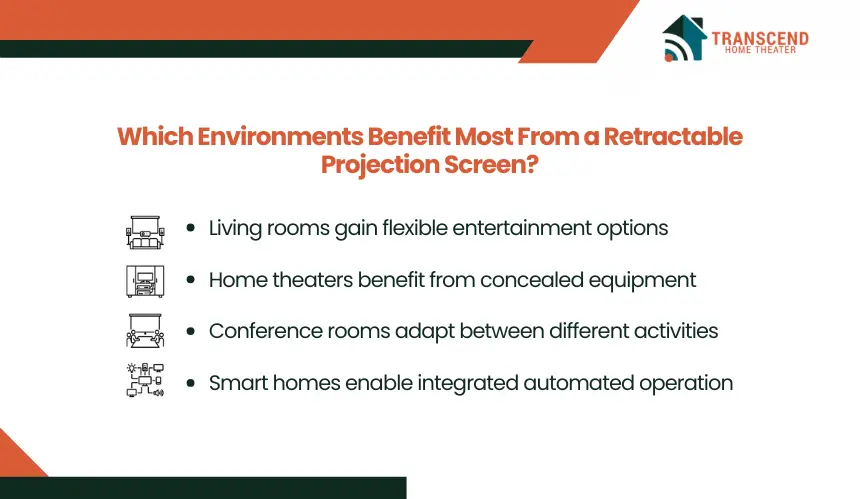
The advantages of a retractable projection screen become more apparent when evaluated within the context of the room it serves. Different environments place different demands on space, aesthetics, and functionality, making retractable systems a stronger fit for some applications than others.
Living Rooms and Media Rooms
Living rooms and media rooms often combine television viewing, social gatherings, gaming, and everyday family activities. In these environments, dedicating an entire wall to a fixed projection screen may reduce design flexibility or compete with other furnishings.
A retractable projection screen allows the entertainment system to remain hidden until needed, enabling the room to function normally throughout the day. This approach is particularly beneficial for homeowners who want large-screen projection without permanently changing the appearance or layout of their primary living space.
Dedicated Home Theaters With Concealed Equipment
Even dedicated home theaters can benefit from a retractable projection screen when concealment is part of the overall design objective. Some homeowners prefer to hide projection equipment, speakers, and screens behind architectural finishes or automated systems, creating a cleaner and more refined environment when the theater is not in use.
This design philosophy is increasingly incorporated into home theater design and installation in Washington, DC, where custom entertainment spaces are often planned alongside premium interior finishes and integrated smart home technology.
In these projects, a retractable screen complements concealed equipment while preserving the room’s architectural character without sacrificing viewing performance.
Conference Rooms and Commercial Presentation Spaces
Business environments frequently require a room to transition between meetings, presentations, video conferencing, and collaborative work. A permanently exposed projection screen may not be necessary for every session and can limit how the room is perceived during non-presentation activities.
A retractable projection screen allows presentation technology to remain available without dominating the workspace. Combined with ceiling-mounted projectors and integrated control systems, it creates a professional meeting environment that adapts quickly to changing operational needs.
Luxury Smart Homes With Integrated Automation
Retractable projection screens integrate naturally into automated residential environments where multiple systems operate together through a centralized control platform. Homeowners can coordinate screen deployment with projector activation, lighting scenes, motorized shades, and audio settings using a single command or pre-programmed routine.
This level of integration supports a seamless viewing experience while keeping technology unobtrusive during everyday use. For homes designed around automation, a retractable projection screen often aligns more closely with the overall objective of combining performance, convenience, and clean interior aesthetics.
Ready to create a projection system that fits both your space and your lifestyle? Transcend Home Theater designs and installs custom projection systems, retractable projection screens, and integrated home theater solutions tailored to your home’s layout and entertainment goals.
Whether you’re planning a dedicated theater or upgrading a multi-purpose living space, our team serves homeowners throughout the Washington, DC metro area, including Northern Virginia and suburban Maryland, with professionally designed AV solutions built for long-term performance.
Frequently Asked Questions
Are tab-tensioned retractable screens worth the extra cost?
Tab-tensioned screens are usually worth the upgrade when image uniformity matters, especially with 4K projectors or content containing straight lines and fine detail. Side tension reduces edge curl and surface waves that may appear on basic roll-down screens. The added cost is less critical for occasional presentations or lower-resolution viewing.
Can a retractable projection screen work with an ultra-short-throw projector?
Most standard retractable screens are not ideal for ultra-short-throw projectors because even minor surface movement can distort the image. UST systems require an exceptionally flat, properly tensioned screen, often with an ambient-light-rejecting surface designed specifically for steep projection angles. Compatibility should be confirmed before purchasing either component.
Can speakers be installed behind a retractable projection screen?
Speakers can be placed behind the screen when an acoustically transparent retractable material is used. The woven or perforated surface allows sound to pass through while keeping dialogue aligned with the image. Installation must account for speaker distance, light spill, moiré risk, and enough screen drop to cover the complete speaker array.
Is a motorized screen better than a manual pull-down screen?
Motorized screens provide smoother deployment, consistent stopping positions, and easier integration with projectors, lighting controls, and smart home systems. Manual screens cost less and require no electrical connection, but repeated pulling can create uneven wear or positioning. The better option depends on usage frequency, control expectations, and installation access.
What happens to a motorized projection screen during a power outage?
Most motorized screens remain in their current position when power is interrupted. Some models include a manual override, low-voltage control option, or battery-backed automation system, but these features are not universal. Buyers should confirm emergency retraction, limit-switch memory, and service access before installing the housing inside a finished ceiling.
Can a recessed retractable screen be added to an existing finished room?
A recessed installation may be possible, but it depends on joist direction, ceiling depth, electrical access, ductwork, plumbing, and the screen housing dimensions. Retrofitting often requires selective drywall removal and refinishing. Surface-mounted housings provide a less invasive alternative when structural conditions prevent the screen from being concealed above the ceiling.
How long does a retractable projection screen typically last?
A retractable projection screen can remain operational for 10,000 deployment cycles or more when properly installed and maintained. That equals about 40 years at 250 cycles per year or 20 years at 500 cycles per year. Screen fabric, motors, tensioning components, and controls may need earlier service depending on heat, humidity, alignment, and usage frequency.