
What Is Structured Wiring in a Smart Home?
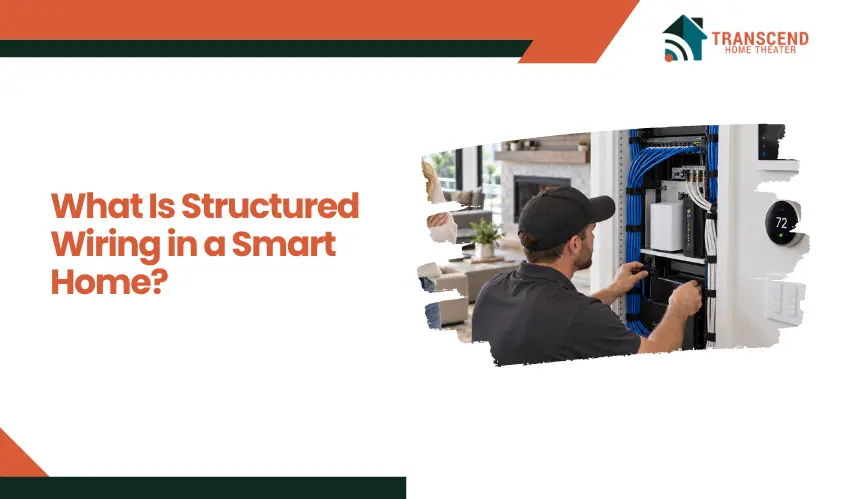
Quick Answer: Structured wiring is a centralized low-voltage cabling system that connects smart home devices, networks, security cameras, Wi-Fi access points, audio/video equipment, and automation controls through dedicated cable runs. It creates a more reliable backbone than relying on wireless connections alone, while also making future upgrades, troubleshooting, and system expansion easier. Modern smart homes often combine structured wiring with Wi-Fi and other wireless protocols for flexibility. |
Smart home devices depend on more than Wi-Fi. Behind many reliable home networks, security systems, audio setups, and automation platforms is a planned low-voltage cabling infrastructure known as structured wiring.
Structured wiring organizes cables and connection points through a centralized system, creating a physical backbone for moving data, audio, video, and control signals throughout the home.
This guide explains what structured wiring is, how it supports a smart home, and what to consider when planning the infrastructure.
How Does Structured Wiring Work in a Smart Home?
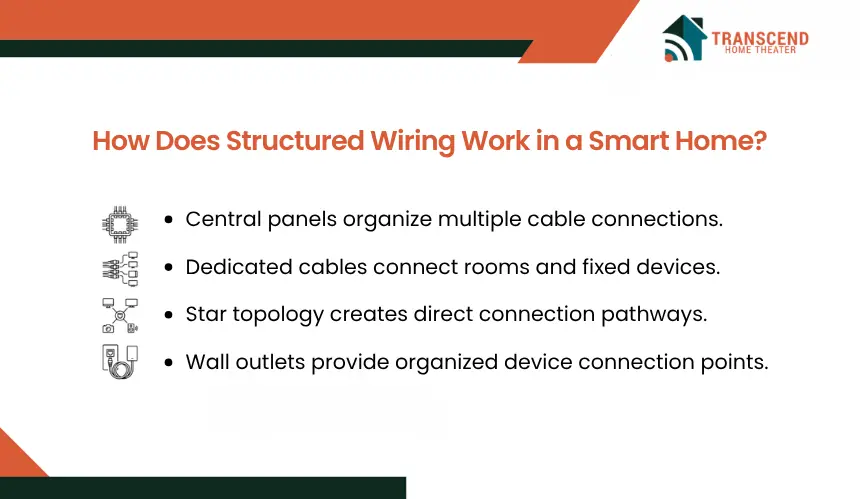
Structured wiring uses dedicated cable runs to connect rooms and fixed devices to a central distribution location. Instead of treating each network, entertainment, or low-voltage connection as an isolated installation, the system creates an organized infrastructure that can be terminated, connected, and managed from one location.
The Central Structured Wiring Panel
A structured wiring panel, sometimes called a structured media enclosure or distribution panel, serves as the central termination point for compatible low-voltage cabling. It is typically installed in an accessible utility, mechanical, or dedicated equipment area.
Ethernet, coaxial, telephone, and other supported cable runs can terminate at this location. Depending on the system design, the enclosure may contain patch panels, splitters, distribution modules, or related connection hardware.
Network equipment such as switches may be installed inside the enclosure when space, ventilation, power, and manufacturer requirements allow, or positioned in a nearby equipment rack.
Centralizing these terminations gives technicians a defined location for identifying individual cable runs and connecting them to the appropriate services.
Cables, Wall Outlets, and Connection Points
From the central location, individual cables are routed through walls, ceilings, or conduit to planned termination points throughout the house. The cable type is selected according to the signal or equipment it needs to support.
Category-rated Ethernet cable, such as Cat6, is commonly used for data connections and compatible Power over Ethernet devices. Coaxial cable may serve television or RF applications, while speaker wire connects passive speakers to amplification equipment. Fiber-optic cabling can also be incorporated when the installation requires specific bandwidth, distance, or electrical-isolation characteristics.
At the room end, these runs typically terminate at wall plates, network jacks, equipment locations, ceiling access points, or dedicated device positions rather than leaving loose cabling exposed.
How Do Signals Travel From the Panel to Devices?
Many structured wiring systems follow a home-run or star topology, meaning each connection point has its own cable running back to a central location rather than passing sequentially from one room to another.
For example, an Ethernet jack in a home office can have a dedicated cable terminating at a patch panel. A patch cable can then connect that run to a network switch, allowing the connected computer or other device to communicate with the home network.
The same physical organization can serve multiple endpoints across the property. Each cable has a defined origin and destination, creating a traceable pathway between central equipment and individual connection points.
What Can a Structured Wiring System Support?
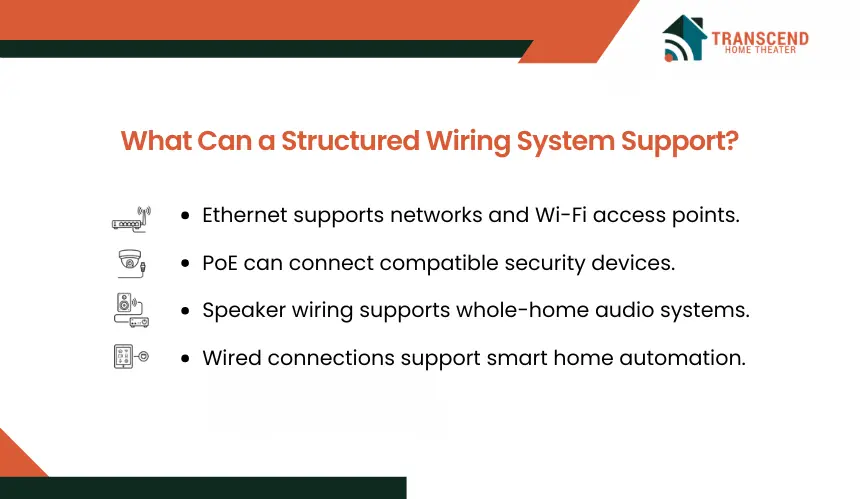
A structured wiring system can support the fixed infrastructure behind networking, security, entertainment, and home automation. The exact configuration depends on the devices being installed, their bandwidth and power requirements, and whether they communicate through Ethernet, dedicated low-voltage cabling, or another connection standard.
Home Networks and Wi-Fi Access Points
Structured Ethernet cabling can provide direct network connections for computers, televisions, streaming equipment, gaming systems, and other stationary devices. It can also connect strategically positioned wireless access points back to the network switch through wired Ethernet backhaul.
This matters in larger or multi-level homes where a single wireless router may not provide consistent coverage. Ceiling-mounted access points connected by Ethernet can distribute Wi-Fi closer to the areas where devices are actually used without relying on a wireless link between access points.
Smart Security and Surveillance
Security equipment often has fixed installation locations, making it well suited to preplanned cabling. Ethernet can connect compatible IP cameras, network video recorders, access control equipment, and certain door stations directly to the home network.
Power over Ethernet (PoE) can carry electrical power and network data over the same compatible Ethernet cable. This allows supported cameras, access points, intercoms, and other PoE devices to operate without a separate electrical outlet at every installation point.
For homes in Virginia, cabling planned during construction or renovation can be particularly useful when security devices need to cover entrances, driveways, detached structures, or other predetermined locations around the property.
Whole-Home Audio and Video
Distributed entertainment systems require different connections depending on how audio and video are designed. Passive architectural speakers commonly use dedicated speaker wire routed back to an amplifier or equipment location, while smart televisions, streaming players, receivers, and networked AV equipment can use Ethernet.
Structured cabling can also accommodate compatible AV distribution equipment when content needs to reach multiple rooms from centralized source components. The infrastructure should be selected around the actual signal format, distance, bandwidth, and equipment specifications rather than assuming one cable type can handle every AV application.
Smart Home Automation and Control
Home automation platforms may connect lighting controls, touch panels, controllers, sensors, motorized systems, and other integrated equipment through a combination of wired and wireless communication.
Structured wiring provides network or control connections where the automation platform requires them. For example, a central automation processor may communicate with network-connected components over Ethernet while dedicated low-voltage conductors serve specific control interfaces.
In a professionally integrated smart home in McLean, VA, this infrastructure can provide physical connection pathways for multiple subsystems without requiring every automation component to use the same communication method.
Structured Wiring vs. Wireless Smart Home Systems
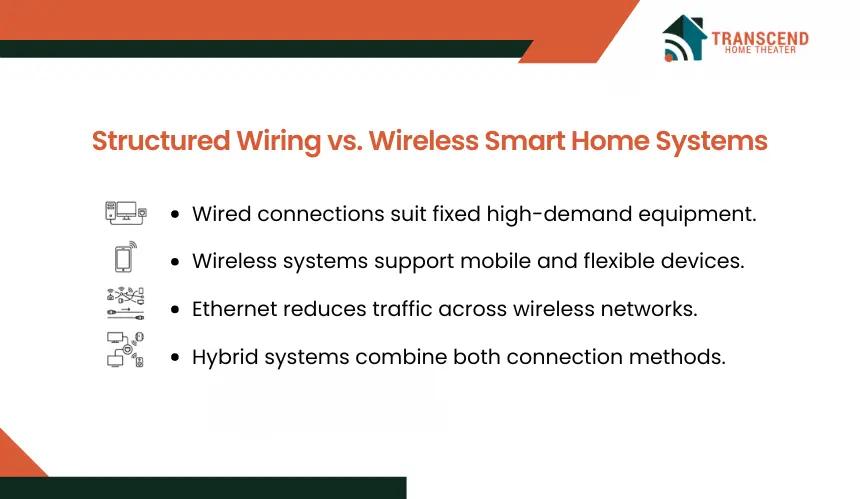
Structured wiring and wireless technology solve different connectivity problems. Wired infrastructure is typically suited to fixed, high-demand, or continuously operating equipment, while wireless protocols provide flexibility for devices that cannot justify a dedicated cable run.
Where Do Wired Connections Perform Better?
Wired connections provide a dedicated physical pathway between compatible network devices. Ethernet can deliver predictable throughput and low latency without competing for the same radio spectrum used by neighboring Wi-Fi networks and household wireless devices.
This makes wired connectivity particularly valuable for IP security cameras, wireless access points, desktop workstations, media equipment, and other stationary devices that continuously transfer data. Compatible Ethernet cabling can also support PoE, allowing certain devices to receive data and electrical power through one cable.
The distinction becomes more relevant as simultaneous network demand increases. Moving suitable fixed equipment onto Ethernet preserves wireless capacity for phones, tablets, laptops, and devices that actually require mobility.
Where Do Wireless Devices Still Make Sense?
Wireless connectivity is practical when running a physical cable would add unnecessary installation work or restrict device placement. Wi-Fi commonly serves mobile and bandwidth-intensive wireless devices, while protocols such as Zigbee and Thread are designed for compatible smart-home products that may exchange smaller amounts of data.
Battery-powered sensors, smart plugs, portable devices, and some retrofit controls are examples where wireless communication can be more practical than opening finished walls for new cabling.
The choice should therefore reflect how a device operates. Mobility, data demand, available power, installation access, protocol compatibility, and required response time all influence whether wired or wireless communication is the better fit.
Why Do Modern Smart Homes Often Use Both?
A hybrid architecture assigns wired and wireless connections according to their strengths. Ethernet can serve fixed network equipment and provide backhaul for access points, while wireless protocols connect mobile devices and compatible endpoints that do not require dedicated cabling.
This approach can be especially relevant in larger properties in McLean, VA, where substantial square footage, multiple floors, finished basements, outdoor living areas, and detached structures can create challenging Wi-Fi coverage conditions.
Rather than expecting one router or a fully wireless mesh to serve every area, wired backhaul can connect access points positioned where coverage is actually required.
Wireless technology still handles the final connection for phones, tablets, sensors, and other appropriate devices. The result is not a choice between wired and wireless systems, but an infrastructure in which each connection method has a defined role.
Why Structured Wiring Matters for Smart Home Performance
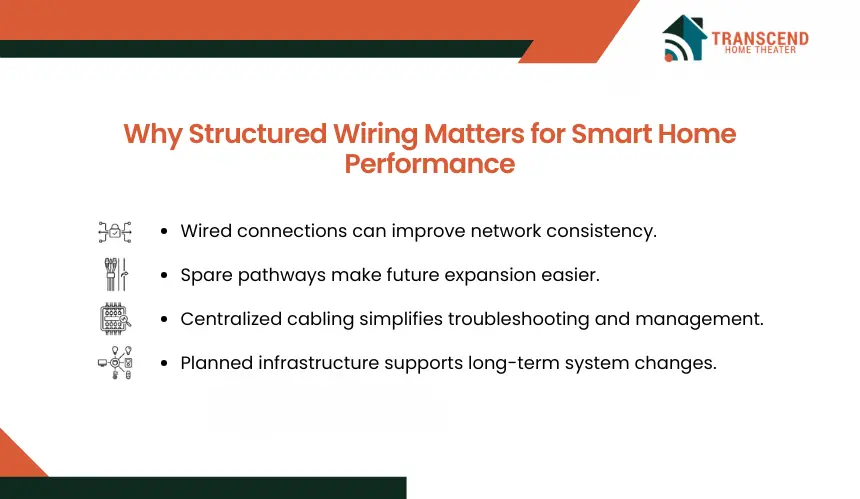
The value of structured wiring becomes clearer as a smart home grows beyond individual connected devices. A planned cabling backbone can affect network consistency, the effort required to expand the system, and how efficiently technicians can isolate infrastructure problems over the life of the home.
More Reliable Network Connectivity
Smart-home performance can deteriorate when too many high-demand devices depend on the same wireless environment. Radio interference, physical obstructions, distance, and competing traffic can affect Wi-Fi performance even when the internet connection entering the property has sufficient bandwidth.
Connecting suitable stationary equipment through Ethernet reduces the amount of traffic that must travel wirelessly. In larger McLean properties, this can be particularly relevant when networked systems extend across multiple floors, home offices, entertainment spaces, exterior cameras, and outdoor areas.
For professionally integrated smart home automation in McLean, VA, the objective is not simply faster internet access. Consistent local network communication can matter when controllers, user interfaces, security equipment, media systems, and other connected components need to exchange commands and data predictably.
Easier Smart Home Expansion
A smart home rarely remains configured exactly as it was on installation day. Additional cameras, upgraded access points, new entertainment equipment, or emerging automation hardware may require connections in locations that were not initially active.
Planning spare cable runs, conduit pathways, unused network ports, and additional capacity at equipment locations creates options for those changes. A homeowner may then be able to activate an existing pathway rather than opening finished walls to establish every new connection.
This is particularly valuable during new construction or major renovation, when installing accessible pathways is considerably less disruptive than creating them after drywall, millwork, built-ins, and finished ceilings are complete.
Cleaner Troubleshooting and System Management
Centralized, labeled terminations give technicians a clearer map of the home’s physical connectivity. When a device loses its connection, individual cable runs can be identified and tested independently rather than tracing undocumented wiring through multiple rooms.
Proper labeling also distinguishes which ports serve specific cameras, access points, televisions, control equipment, or other endpoints. That visibility becomes increasingly useful as the number of connected systems grows.
Structured organization therefore affects long-term serviceability as much as initial installation. Equipment can change over time, but a documented cabling infrastructure gives future technicians a defined starting point for testing, replacement, and system modifications.
What Should Be Planned Before Installing Structured Wiring?
Structured wiring should be designed around where technology will operate, not simply where cables are easiest to install. Before walls are closed or retrofit pathways are selected, the plan should account for device locations, cable specifications, pathway capacity, and reasonable future changes.
Which Rooms and Devices Need Wired Connections?
Start with fixed equipment that has a predictable installation location. Home offices, media rooms, televisions, wireless access points, security cameras, door stations, control panels, and equipment racks are common candidates for dedicated connections.
Planning should also account for less obvious locations. Exterior camera positions may need network cabling under eaves, ceiling-mounted access points require appropriately placed drops, and outdoor entertainment or network coverage may require pathways toward patios and other exterior spaces.
In McLean, VA, structured wiring plans often need to account for large custom homes, multi-level layouts, finished basements, home offices, and expansive outdoor living areas. During a major renovation or custom build, identifying network, security, AV, and automation endpoints before walls and ceilings are finished can avoid difficult cable retrofits across distant rooms, upper floors, and exterior areas.
Choose Cabling for the Intended Application
Cable selection should follow the technical requirements of the equipment rather than a single specification for the entire property. Category-rated Ethernet such as Cat6 may serve many network and PoE applications, while speaker cable, coaxial cable, fiber, and specialized control wiring have different purposes.
Installation conditions matter as well. Cable length, required bandwidth, PoE power level, environmental exposure, termination hardware, and applicable building requirements can influence the correct specification.
Conduit can provide an additional pathway where future cable standards or equipment requirements are difficult to predict. It is particularly useful between critical equipment locations or other areas that would be difficult to access once construction is finished.
How Much Capacity Should Be Planned for Future Technology?
Future-ready wiring does not require predicting every device a homeowner will eventually purchase. It means preserving practical options where expansion is reasonably likely.
That may include extra Ethernet runs to high-use rooms, spare ports at the central equipment location, accessible conduit, additional cable at likely camera positions, or capacity for another wireless access point. These provisions are usually easier to incorporate while pathways are accessible than after interior finishes are complete.
Capacity should still be intentional. Installing large quantities of unused cable without defined destinations adds cost without necessarily making the home more adaptable.
New Construction vs. Retrofit Structured Wiring
New construction provides the greatest routing flexibility because cables and conduit can be installed before drywall and other finishes restrict access. The wiring plan can be coordinated with electrical, HVAC, cabinetry, lighting, security, and AV work so that low-voltage pathways reach their intended endpoints without unnecessary conflicts.
Retrofit projects require a different approach. Technicians may use attics, basements, crawlspaces, closets, existing conduit, or other accessible pathways to reach target locations while limiting disruption to finished surfaces.
The right strategy depends on the home’s construction and the systems being added. A site-specific wiring plan should therefore be developed before equipment installation begins, particularly when the property contains finished architectural details or difficult-to-access areas.
Build your smart home on infrastructure designed for the technology behind it. Transcend Home Theater provides structured wiring, smart home automation, networks and Wi-Fi, smart security, whole-home audio, and integrated technology solutions across the Washington, DC Metro Area, including Maryland, Northern Virginia, and Northwest DC.
Frequently Asked Questions
How much does structured wiring cost in a smart home?
A useful 2026 planning benchmark for professionally installed Cat6 is roughly $150 to $350 or more per completed drop, although residential pricing can vary widely. Finished-wall access, long cable routes, panel work, testing, conduit, patch panels, and difficult architectural conditions can push costs higher, especially in large custom homes.
Will structured wiring still work if my internet goes down?
Structured wiring can continue carrying data across the home even when the internet connection is down. Local devices may still communicate through the home network, but cloud-dependent apps, voice assistants, remote access, and some automation services may stop working. Actual behavior depends on whether the smart-home platform supports local control or requires cloud connectivity.
Is Cat6 enough for a smart home, or should I install Cat6A?
Cat6 is sufficient for many residential Ethernet, PoE, camera, access-point, and AV applications. Cat6A becomes more attractive when full 10-Gigabit Ethernet is required over longer runs or additional crosstalk margin is valuable. The right choice depends on run length, equipment requirements, pathway space, termination hardware, and installation budget.
Can structured wiring be added to an existing home without opening every wall?
Structured wiring can often be added to an existing home without opening every wall. Installers may route cable through attics, basements, crawlspaces, closets, chases, or existing conduit, then make limited access openings near endpoints. Feasibility depends on framing, insulation, fire blocks, masonry, finished ceilings, and how easily vertical pathways can be reached.
Does structured wiring add value when selling a smart home?
Structured wiring does not guarantee a specific increase in resale value, but documented network and low-voltage infrastructure can make a home more attractive to buyers who prioritize reliable Wi-Fi, security, work-from-home connectivity, and smart-home technology. Labeled terminations, usable Ethernet drops, and accessible pathways generally provide more practical value than undocumented cable.
Who should install structured wiring in a smart home?
Structured wiring is usually handled by a low-voltage contractor, network cabling specialist, AV integrator, or smart-home integrator rather than treated as ordinary electrical work. The installer should understand cable separation, bend radius, termination standards, PoE requirements, testing, labeling, equipment-rack design, and local code requirements relevant to low-voltage systems.