
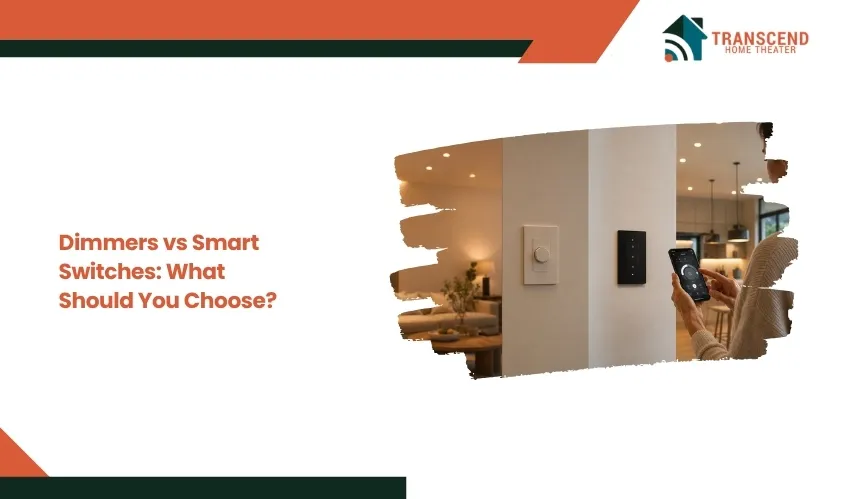
Dimmers vs Smart Switches: What Should You Choose?
Key Takeaways
|
Choosing between a dimmer and a smart switch comes down to how you want to control your lighting. A traditional dimmer focuses on brightness control, while a smart switch adds features such as app access, scheduling, voice commands, and lighting automation.
The right choice also depends on your existing wiring, bulb compatibility, fixtures, and whether you need smart home integration. In some cases, a smart dimmer can provide the benefits of both options.
This guide compares dimmers vs smart switches and explains which lighting control makes the most sense for different needs.
Dimmers vs Smart Switches: What Is the Main Difference?
The main difference is the type of control each device provides. A dimmer changes the electrical output to adjust light intensity, while a smart switch adds connected controls that can turn lighting on or off through digital commands and automation. The exact capabilities depend on the switch model and lighting setup.
What Does a Dimmer Do?
A dimmer switch controls how much power reaches a compatible light source, allowing the user to raise or lower brightness from the wall. Modern dimmers designed for LED lighting use electronic circuitry to regulate output rather than simply switching the circuit fully on or off.
This makes dimmers useful when a room needs multiple lighting levels from the same fixtures. Lower output can create softer ambient lighting, while higher output can provide stronger illumination for reading, cooking, or other tasks.
The bulbs and fixtures must support dimming, and the dimmer itself should be compatible with the connected load to prevent flickering, limited dimming range, or inconsistent performance.
What Does a Smart Switch Do?
A smart switch controls a lighting circuit while adding network-based functions beyond a standard wall switch. Depending on the model and smart home platform, users can operate the lights through a mobile app, voice assistant, preset schedule, or automated routine while retaining physical wall control.
Because the intelligence is built into the switch, one smart switch can control multiple compatible fixtures connected to the same circuit. Some models provide only on/off control, while smart dimmer switches also adjust brightness. This distinction matters because choosing a smart switch does not automatically mean the lighting will be dimmable.
How Dimmers and Smart Switches Compare in Everyday Use
The practical difference becomes clearer during daily use. A dimmer keeps lighting control local and immediate, while a smart switch can extend control beyond the wall through connected features.
Factor | Dimmer | Smart Switch |
Brightness adjustment | Yes | Only on dimming models |
Physical wall control | Yes | Yes |
Mobile app control | No | Typically |
Voice Control | No | Often supported |
Scheduling | No | Typically supported |
Remote Access | No | Typically supported |
Automation | No | Supported on compatible systems |
Installation complexity | No | Typically higher |
Convenience and Control
A traditional dimmer works well when someone is physically in the room and wants immediate control over light output. Turning a dial, moving a slider, or pressing dimming buttons changes the brightness without relying on Wi-Fi, an app, or another connected device.
Smart switches provide more control when lighting needs to respond without direct interaction at the wall. Depending on the system, lights can follow schedules, respond to voice commands, or be controlled remotely from a smartphone. This can be particularly useful for exterior lights, entryways, frequently used rooms, or lights that need predictable operating times.
Installation and Compatibility
Compatibility can determine which option is practical. LED bulbs should be rated as dimmable when paired with a dimmer, and the switch must support the bulb type and electrical load. Poor matching between an LED driver and dimmer can cause flickering, buzzing, delayed response, or a limited brightness range.
Smart switches introduce additional electrical and connectivity requirements. Some require a neutral wire, while others are designed for installations without one. Multi-way circuits, switch-box depth, Wi-Fi coverage, hub requirements, and the chosen smart home platform can also affect installation.
Checking these conditions before selecting a device reduces the risk of buying a switch that cannot operate correctly with the existing lighting circuit.
When Is a Dimmer the Better Choice?
A traditional dimmer is the better choice when the main goal is adjustable brightness without connected controls or automation. It provides direct control at the wall while keeping the lighting system relatively simple.
A dimmer makes practical sense when homeowners:
- Primarily want to raise or lower light levels
- Prefer straightforward physical controls
- Do not need app-based or voice control
- Want to create different lighting moods within one room
- Need flexible illumination for both tasks and relaxation
This approach works particularly well in dining rooms, bedrooms, living rooms, and home theaters, where the required light level changes throughout the day or according to how the space is being used. Lowering brightness can reduce glare and create softer ambient light, while full output remains available when stronger illumination is needed.
Traditional dimmers can also suit homes in Chevy Chase, MD, where homeowners want more flexible lighting without adding connected technology throughout the property.
When automation, scheduling, and remote access are unnecessary, a properly matched dimmer and dimmable LED setup can deliver the required control with fewer system dependencies.
When Is a Smart Switch the Better Choice?
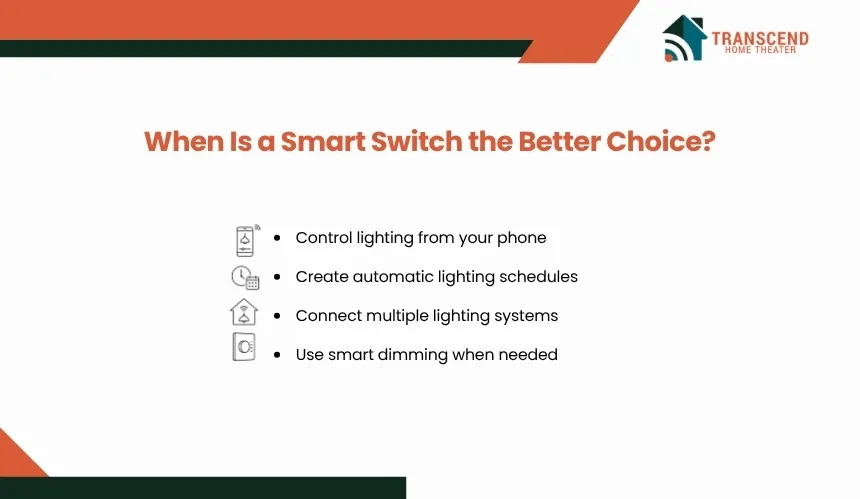
A smart switch is the better option when lighting needs to operate as part of a connected home rather than through manual wall control alone. It is most valuable when homeowners want lights to respond automatically to routines, occupancy patterns, time-based events, or other smart devices.
A smart switch is generally worth choosing when the goal includes:
- Controlling lights from a phone or voice assistant
- Running lights on automatic schedules
- Coordinating multiple fixtures or rooms
- Creating repeatable lighting routines
- Connecting lighting with other home automation systems
How Do Smart Switches Support Lighting Automation?
Smart switches can make lighting respond to predefined conditions rather than requiring someone to operate each switch individually. For example, exterior lights can activate around sunset, entry lighting can turn on when someone arrives home, or selected fixtures can shut off automatically at bedtime.
More advanced smart home automation installation can coordinate lighting with motion or occupancy sensors, security systems, motorized shades, and other connected devices. In a larger Chevy Chase home, centralized routines can reduce the need to manage individual switches across multiple rooms while keeping physical wall controls available.
When Does a Smart Dimmer Make More Sense?
A smart dimmer is useful when a homeowner wants connected control without giving up adjustable light levels. Instead of choosing between automation and dimming, one device can support both functions when paired with compatible fixtures and bulbs.
This option is particularly suited to living spaces, kitchens, bedrooms, and entertainment areas where brightness requirements change throughout the day. Preset lighting scenes can recall specific light levels for activities such as dining, entertaining, watching television, or winding down at night, making the lighting system more adaptable than either basic on/off control or manual dimming alone.
Turn everyday lighting and entertainment into a connected experience with Transcend Home Theater. From professional home theater installation to smart home automation, we design integrated systems around how you use your space. Serving the Washington, DC Metro area, including Maryland, Virginia, and Northwest DC, our team can help you build a home that is easier to control and enjoy.
Frequently Asked Questions
Can a smart switch still work if the Wi-Fi goes down?
Most smart switches continue to function as normal physical wall switches during a Wi-Fi outage. App control, cloud-based automation, and some voice commands may stop until connectivity returns. Systems using local hubs or local processing can preserve more automation functions than devices that depend entirely on cloud communication.
Are smart switches better than smart bulbs for whole-room lighting?
Smart switches are usually more practical when one circuit controls several fixtures because the entire group remains controllable from the wall. Smart bulbs work better when individual lamps need separate colors or brightness levels. Using smart bulbs with a standard wall switch can create problems if someone accidentally cuts power to the bulbs.
Can smart switches be used in three-way or multi-way lighting circuits?
Many manufacturers offer smart switches designed specifically for three-way or multi-way circuits, but installation requirements vary. Some systems need a compatible companion switch, while others work with an existing mechanical switch. Matching the product to the circuit configuration is essential because a standard single-pole smart switch may not function correctly in a multi-location setup.
What happens to a smart switch after a power outage?
After power returns, most smart switches reconnect automatically to the home network and resume normal operation. Some models let homeowners choose whether the connected light stays off, turns on, or returns to its previous state. This power-restoration behavior is worth checking for bedrooms, exterior lighting, and automated nighttime routines.
Do smart switches use electricity when the lights are off?
Smart switches consume a small amount of standby power because their wireless radios and control electronics remain active. Individual consumption is generally low, but it varies by device and communication standard. Wi-Fi, Zigbee, Z-Wave, Matter, and hub-based products can have different standby requirements depending on how they maintain connectivity.
Can I mix traditional switches, dimmers, and smart switches in the same home?
A home can use different control types in different rooms without requiring every switch to be smart. Many homeowners keep traditional dimmers where simple brightness control is sufficient and use smart switches where automation adds value. The key is maintaining electrical compatibility and selecting devices that work consistently with the broader lighting and automation system.